November 5, 2026
Large Firms Use AI at More Than Twice the Rate. The Gap Closes One Job at a Time.
Per a Nov 5 international economic report, 52% of large firms used AI in 2025 versus 20% of firms overall — and the gap is projected to persist. Why the gap is a buying problem, and how a service business closes it one wired-in job at a time.

Per a Nov 5 international economic report, AI was used in 2025 by 20% of enterprises with 10 or more employees across the OECD — compared with 52% of large enterprises with 250 or more employees. Large firms are more than twice as likely to use AI as the average firm, and the report projects that the divide will persist without targeted support: by the end of the decade, AI uptake among large firms could be nearly 80% higher than the average across all firms. For a small or local business, that reads like a verdict. It is actually a diagnosis — and the diagnosis points at the cure.
The numbers, exactly as reported
- 20% of firms (10+ employees) used AI in 2025; 52% of large firms (250+) did.
- Only around 12% of firms combine AI with cloud computing and big data analytics.
- Generative AI use among individuals reached 37% in 2025 — but only 14% of older adults used it, versus 68% of 16- to 24-year-olds.
- Investment is not the constraint at the top of the market: venture capital in AI infrastructure firms more than doubled, from $54.5 billion in 2024 to $123.9 billion in 2025.
Two disciplines before building a plan on this data. First, these are adoption figures, not outcome figures — the report measures who uses AI, not who profits from it. Second, the averages blend every sector and size band; a service business should benchmark against its own trade and town, not against a multinational's IT department. Neither caveat softens the central fact: adoption is compounding fastest where firms have staff whose job is adoption.

Why the gap is a buying problem
The report names the constraints on smaller firms directly: limited access to finance, digital infrastructure and specialised skills; implementation costs; uncertainty about legal and data-protection requirements; and difficulty integrating AI into existing systems. Notice what is absent from that list: owners doubting that AI works, or customers refusing it.
Every constraint named is a property of how enterprise AI is sold — programmes, integrations, transformation roadmaps — not a property of the technology's usefulness at small scale. A contractor does not need an AI strategy department. A contractor needs the phone answered when the crew is on a roof. The gap persists because the offer is sized for the 52%, while the need is identical in the 20%.
What closing the gap actually looks like
The large firm's advantage is not intelligence or budget size; it is that someone owns the wiring. Closing the gap at small scale means shrinking the job until one owner can wire it end to end:
- One job, fully wired — every call answered, qualified and booked; not "AI somewhere in the business."
- A number the owner already watches — missed calls per week, follow-ups completed, bookings confirmed in writing.
- The team working inside it daily — a system the crew routes around is a subscription, not an installation.
That is the same depth the top adopters have, applied to the one workflow where a local business bleeds money daily. Depth on one job beats breadth across ten experiments — the adoption statistics reward firms using AI; the profit statistics reward firms that finished wiring it in.
The practical takeaway
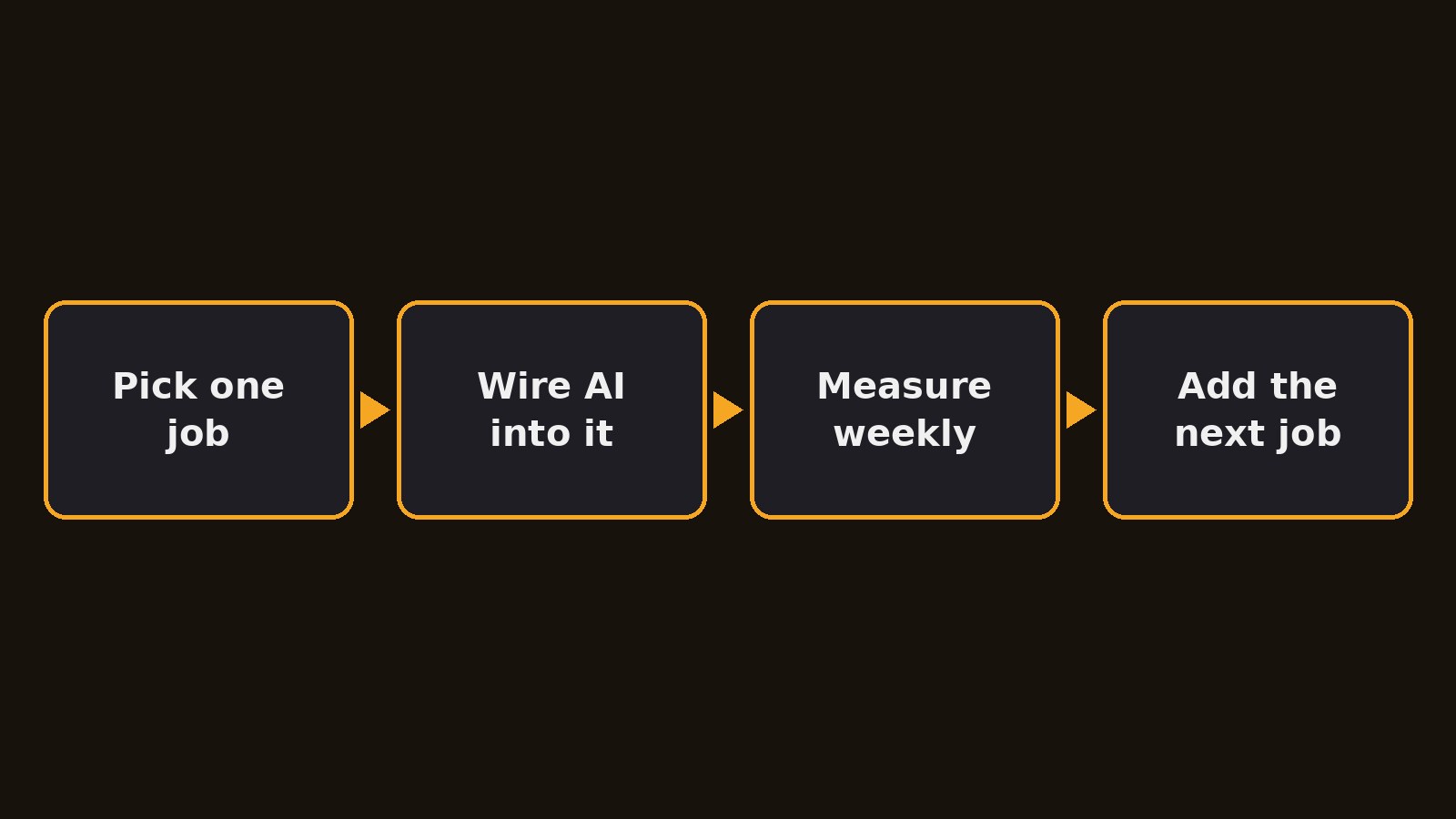
- Pick the job where money already leaks. For most service businesses that is the inbound call and the follow-up queue.
- Buy the job, not the programme. If a proposal needs a transformation roadmap to justify itself, it is sized for a large firm, not for you.
- Measure weekly, then add the next job. Adoption compounds the same way for a five-person firm as for a five-thousand-person one — one finished job funding the next.
Hear what the first wired-in job sounds like on a live call: +1 866-476-5928 — a free 2-minute demo of Grace AI, the Scale Matrix AI receptionist. Scale Matrix AI puts AI voice agents and workflow systems to work for contractors, home services, local businesses, and other service businesses: AI Automations That Give You 10 Hours Back Every Week.